

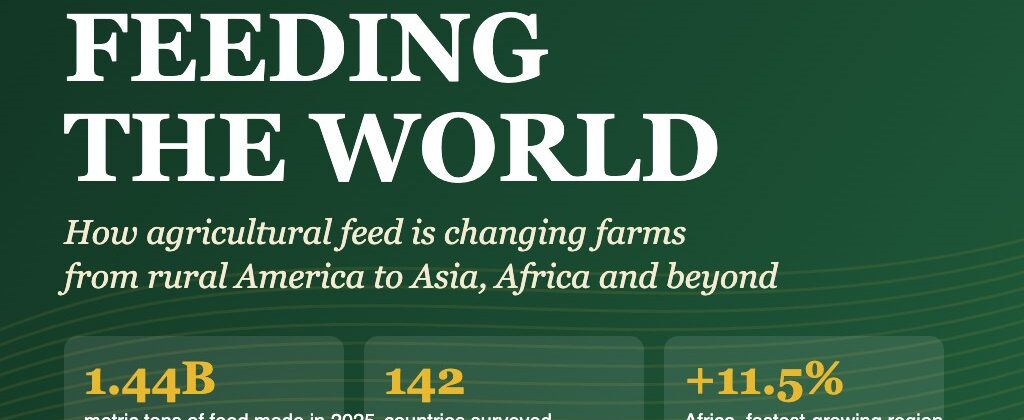
China makes the most feed, poultry eats the most of it, and Africa is growing the fastest. Here is who is winning the race to fill the trough, and what comes next.
By the Today Publications Ag Desk | Data: Alltech 2026 Agri-Food Outlook
Every steak, gallon of milk, carton of eggs and fillet of fish starts in a feed bin. In 2025 the world’s feed mills turned out an estimated 1.44 billion metric tons of compound feed, an increase of 2.9% over 2024, according to the 2026 Alltech Agri-Food Outlook. That annual survey gathered data from 38,837 feed mills in 142 countries. Behind that headline is a quiet revolution: sharper formulas, enzymes and probiotics, data-driven rations, new protein sources, and a production map that is shifting east and south.
The American Heartland
The United States remains the world’s No. 2 feed maker at 267.4 million tons, about 19% of the world’s total. But 2025 was a mixed year at home. North America as a whole slipped 0.7% to about 288.6 million tons, held back by a historically tight cattle cycle and a shrinking beef herd. Broilers and dairy kept growing, pork feed stabilized, and egg and turkey flocks began recovering from disease disruptions.
For rural producers, feed is typically the largest single line in a livestock budget, so even small gains in feed efficiency matter. Mills are answering with efficiency upgrades, optimized formulations and consolidation, while sustainability pressure pushes new additives and tighter nutrient use. That is why precision formulation, better ingredient sourcing and local mill relationships keep rising on the priority list for farms and co-ops.
Who Makes the Most?
China is the volume king at 330.1 million tons, up 4.8%, as farmers move from on-farm mixing to commercial feed. Brazil, at 89.9 million tons, rides export demand for protein. India (+4.5%) and Türkiye (+3.8%) are climbing fast, while Spain (−3.4%) and Japan (−1.3%) shrank. The ten biggest feed-producing nations made 65.2% of all the feed on Earth in 2025.
Top 10 Feed Nations · 2025
Money Matters
U.S.: about $70B in 2025 to roughly $84B by 2035 (about 1.8% a year): slower, steadier and more efficiency-driven.
Growth is coming from better productivity and industry transformation, not simply more animals.The takeaway · Alltech 2026 Agri-Food Outlook
The Global Feed Bunk
Asia
RecordThe global center of feed. China’s shift to commercial feed and surging poultry and aquaculture demand drove output; Southeast Asia’s sow herd recovery lifted pork feed, though disease remains a threat. India (+4.5%) and Vietnam (+2.6%) are growing fast.
North America
−0.7%A tight cattle cycle trimmed tonnage, yet broilers and dairy grew. Mexico, the region’s other giant at about 41.9 million tons, grew 1.2%.
Europe
+1.0%Big harvests lowered raw-material prices, lifting margins, with modest dairy and broiler gains. Disease and regulation remain brakes; Spain fell 3.4%.
Africa
+11.5%Commercialization is the story: more farmers buy compound feed instead of mixing by hand, opening a long runway for poultry, dairy and fish. (Africa and the Middle East together made about 102.6 million tons.)
Latin America is led by Brazil, the world’s No. 3 feed maker at 89.9 million tons (+2.8%), where export demand and a growing appetite for protein keep mills busy.
What Is the Best-Selling Feed on Earth?
“Best” depends on how you count, but by tonnage the answer is clear: poultry feed. Broilers consumed 400.4 million tons in 2025 (+3.7%), narrowly ahead of pigs at 380.9 million (+3.0%). Layers took 180.1 million, dairy 170.3 million and beef 134.2 million. The fastest-growing major category was aquaculture, up 4.7% to 55.5 million tons. Pet food reached 39.3 million and equine feed 10.2 million.
The brands behind the bags
By volume, Chinese giants dominate the most recent published ranking (2023 volumes, from Feed Strategy): New Hope Group, Haid Group and Muyuan lead, followed by Cargill and CP Group. Volume measures scale, not quality, so the “best” feed for your operation is the one with the right nutrient guarantees, proven trial data and dependable local service.
Feed by Species · 2025
Top 10 Feed Companies
- New Hope GroupChina
- Haid GroupChina
- Muyuan FoodstuffChina
- CargillU.S.
- CP GroupThailand
- Wen’s Food GroupChina
- Twins GroupChina
- Land O’LakesU.S.
- Tyson Foods (broiler)U.S.
- De HeusNetherlands
What the Future Holds: Smarter, Greener, Leaner
Precision Nutrition
Sensors, software and AI tailor rations to each species, age and health status, cutting waste and improving feed conversion.
Enzymes & Probiotics
Gut-health tools pull more nutrition out of every pound of grain and soy and reduce reliance on pricey ingredients.
New Proteins
Insect meal and other alternative proteins ease soy dependence; seven insect species are already authorized in the EU for feed.
Lower Emissions
Methane-reducing additives and tighter nutrient use are entering the mainstream, and the debate is lively. Weigh the manufacturers’ data and the independent research.
Bottom line: expect steady global growth (around 4.7% a year to 2032 by one analyst estimate), faster commercialization in Africa and Asia, and a U.S. market that grows slowly but competes harder on efficiency and data. These are third-party estimates and methods vary.
Watch & Learn
Feed technology videos · click to open▶ Watch on YouTube
▶ Watch on YouTube
▶ Watch on YouTube
▶ Watch on YouTube
Quick Answers: Feed FAQ
Which country produces the most animal feed?
China, at about 330 million metric tons in 2025, roughly 23% of the world’s total, followed by the United States (about 267 million) and Brazil (about 90 million).
What is the most-produced type of animal feed?
Poultry (broiler) feed, at about 400 million metric tons in 2025, narrowly ahead of pig feed at about 381 million.
Which region is growing fastest?
Africa, up 11.5% in 2025 as more farmers move to commercial compound feed. Among the big producers, China (+4.8%) and India (+4.5%) grew fastest.
How much feed does the world make each year?
An estimated 1.44 billion metric tons of compound feed in 2025, up 2.9% from 2024.
What is next for animal feed?
Precision nutrition, enzymes and probiotics, alternative proteins such as insect meal, and additives that reduce emissions.
Reach farmers where they read. We put your ag business in front of 155,000+ customers every month through our interactive digital publication.
- A free landing page for advertisers, with an analytics report every 30 days
- Ag show promotions that put your brand in front of buyers
- Website design built to turn farm traffic into leads
- An interactive digital issue with video, direct website links and editorials